Takayama Tatsu — the first woman on record to break the ban, disguised as a man.
During the Edo period, Mount Fuji was subject to a religiously-motivated ban on women, who were only
permitted as far as the 2nd or 4th station. The first woman on record to break this ban and reach the
summit was Takayama Tatsu. In 1832, Tatsu is said to have disguised herself as a man, blended in among
other climbers, and accomplished the ascent to the summit.
It would be another 40 years before the ban on women was formally lifted, by decree of the Meiji
government in 1872. Takayama Tatsu's challenge — undertaken by one woman's own will, long before the
system itself changed — is still remembered today as a record of breaking through both faith and custom.
02
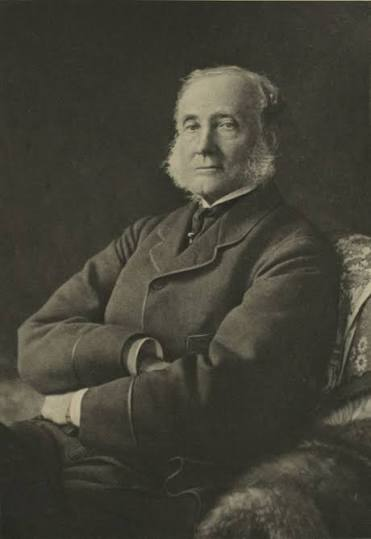
Rutherford Alcock — the first foreigner to reach the summit.
In 1860, near the end of the Edo shogunate, Rutherford Alcock, Britain's first Consul-General to Japan,
is recorded as the first foreigner ever to reach the summit of Mount Fuji. The shogunate initially balked
at his request to climb, but ultimately granted permission, and Alcock's party summited via the Omiya-
Murayama-guchi route.
Alcock recorded this climb in detail in his book "The Capital of the Tycoon," which today serves as a
valuable record of Japanese customs still marked by the lingering closed-country era, as well as the
people he encountered on the mountain, all observed through a Western lens.
Rutherford AlcockBritain's first Consul-General to Japan
03
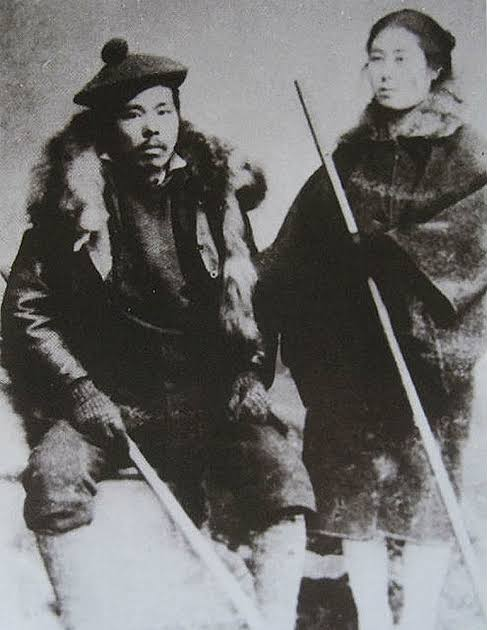
Nonaka Itaru & Chiyoko — the couple who risked everything on a winter summit.
In 1895, at a time when almost no data existed on the upper atmosphere, meteorologist Nonaka Itaru
reasoned that observing weather year-round at the summit of Japan's tallest mountain could dramatically
improve forecast accuracy. He spent his own money to build a small observation hut at the summit and
attempted to overwinter there alone to observe conditions through the season.
Worried for her husband, his wife Chiyoko climbed to the summit against everyone's objections and joined
him in the observations. At 3,776 meters, the summit was an unimaginably brutal environment given the
equipment of the time, and the two eventually succumbed one after another to altitude sickness and severe
exhaustion, forced to descend. A desperate rescue party from the foot of the mountain managed to save both
their lives, but the attempt fell short of its original goal of year-round winter observation.
Remembered as "The People of the Lotus": The Nonakas' challenge and its aftermath later
became the subject of Nitta Jiro's novel "Fuyo no Hito" ("The People of the Lotus"), bringing it wide
recognition. Nearly half a century after this life-risking attempt, in 1932, the Central Meteorological
Observatory formally established a year-round observatory at the summit. The Nonakas' challenge is
remembered as its forerunner.
Nonaka Itaru & ChiyokoWho attempted winter observation at the summit
04
Kakugyo and Jikigyo Miroku — the cave ascetic and the leader who died fasting.
As detailed on the "Fuji-ko Faith" page, Kakugyo, founder of Fuji-ko, secluded himself in the lava cave
Hitoana and performed severe austerities to establish his own system of belief. His teaching was carried
on and spread explosively among Edo commoners by Jikigyo Miroku, said to have died fasting at Eboshi-iwa
near the 7th station in 1733. Together, faith and practice make up the core of Mount Fuji's uniquely
human history.
Next
After a life-risking challenge, a warm bowl feels just right.
Mount Fuji and its foothills have nurtured more than just faith and history. The next page introduces
the distinctive food culture born from lava and spring water.