A change of course
As interest in World Heritage listing grew within Japan during the 1990s, Mount Fuji was considered as a candidate. But at the time, major issues — litter at the summit, sewage treatment, and the impact of mountain huts and tourism development on the landscape — made it clear that registration as a "World Natural Heritage" site, which demands rigorous standards for natural preservation, was not realistic.
Japan changed its strategy, and instead of focusing on the mountain's natural qualities, recommended it for registration as a "World Cultural Heritage" site, highlighting its cultural value as a long-standing object of mountain worship and a wellspring for countless works of art, from Hokusai's woodblock prints onward. This shift in approach paid off, and in 2013 Mount Fuji was formally registered as a World Cultural Heritage Site, under the name "Fujisan, sacred place and source of artistic inspiration."
25 component assets
Mount Fuji's World Cultural Heritage registration isn't limited to the mountain itself. The Fuji Five Lakes, Shiraito Falls, Oshino Hakkai, the Hitoana Fuji-ko Site, the oshi lodging houses, and clusters of Sengen shrines are all registered together as a set of 25 component assets substantiating its value as a source of both faith and artistic inspiration.
A 45km reversal
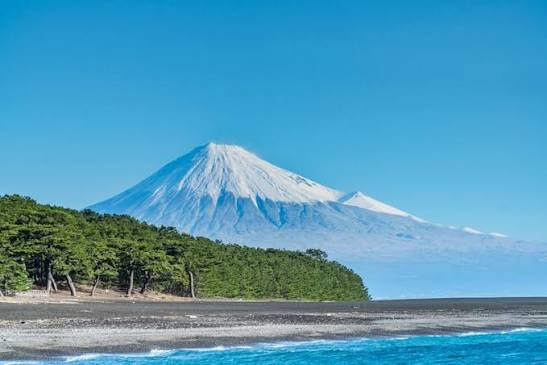
Just before the final decision, in late April 2013, ICOMOS (the International Council on Monuments and Sites), the advisory body reviewing the listing, recommended excluding one component asset — "Miho no Matsubara," a pine-lined coastline — from the registration. The reasons given were its distance of about 45 kilometers from Fuji itself, and concerns that the wave-breaking structures (resembling tetrapods) installed along the coast were unsuited to the landscape.
In response, the city of Shizuoka launched a large-scale cleanup campaign involving citizens and even players from the J-League club Shimizu S-Pulse, while also lobbying the 21 member states on the World Heritage Committee. At the committee's main session that June, Germany's delegate praised the view from Miho no Matsubara, prompting Russia, Senegal, Malaysia, and others to voice support in turn. The exclusion recommendation was ultimately overturned, and Miho no Matsubara was formally registered as part of "Mount Fuji"'s World Cultural Heritage listing.
An ongoing challenge
World Heritage registration further raised Mount Fuji's profile and climber numbers, but has also brought new challenges of overtourism and environmental strain. Shizuoka and Yamanashi Prefectures have introduced voluntary or partly mandatory "climbing cooperation fees," and in recent years have implemented or discussed caps on the number of climbers and nighttime closures aimed at curbing "bullet climbing." The World Heritage title has been both an honor and a new burden for Mount Fuji.
Next
"Who does the mountain actually belong to?" — Mount Fuji still gives a definite answer to that seemingly simple question. The next page introduces these urban legends and strange-but-true facts.
Read the Urban Legends →