Home / Fuji-ko Faith

05 — Faith

"808 confraternities in Edo,
80,000 members."

During the Edo period, faith in Mount Fuji exploded into a mass movement of commoners known as "Fuji-ko" (Fuji confraternities). It's said to have been so widespread that people spoke of "808 confraternities in Edo, 80,000 members," and miniature replica mountains called "Fujizuka" were built all across the city so people could climb a stand-in for Fuji itself. At its source stand one ascetic who performed austerities in a cave that verge on the bizarre, and another leader who ultimately ended his own life through fasting.

Fujizuka — a small Fuji, built in Edo

The founder's life

Kakugyo — the man who spent 1,000 days standing on ice in a cave.

Kakugyo (also called Fujiwara no Kakugyo), an ascetic active from the late Sengoku period into the early Edo period, is considered the founder of Fuji-ko. According to legend, after traveling the country in ascetic practice, Kakugyo arrived at "Hitoana," a lava cave at the foot of Mount Fuji, and made it his base for severe training — including standing on tiptoe atop a sheet of ice for days on end, a practice known as "toe-standing austerity," among other feats said to defy ordinary human endurance.

Kakugyo systematized his own incantations, prayer methods, and the practice of "nichihai" (worshipping the sunrise each morning), teaching devotion to Mount Fuji as the sacred dwelling place of "Sengen Daibosatsu." This teaching spread to Edo commoners through his disciples, and is considered the direct source of the later Fuji-ko boom.
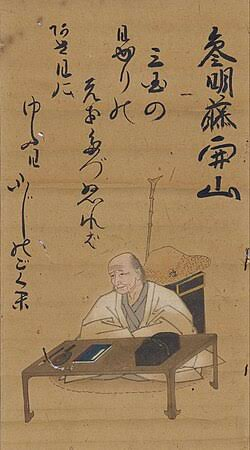
A portrait scroll of a man seated at a desk, labeled with the title used for Kakugyo
A hanging scroll said to portray KakugyoDepicted under the honorific title "Sanmyo Toukaisan"

The reviver

Jikigyo Miroku — the leader who died fasting, high on the mountain.

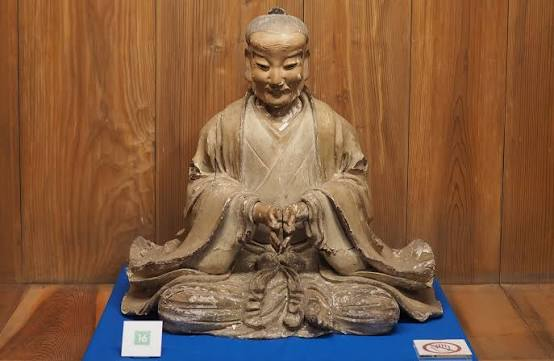
The man who spread Fuji-ko explosively among the commoners of Edo was Jikigyo Miroku, said to be a disciple several generations removed from Kakugyo. Believed to have been born in Ise, Miroku made his living selling oil while deepening his understanding of the Fuji-ko teachings, and is said to have preached a surprisingly progressive doctrine for its time — that Mount Fuji itself was a mountain of the gods and buddhas meant to bring equality to the world.

In 1733, at age 63, Miroku climbed Mount Fuji and began fasting at a rock formation near the 7th station called "Eboshi-iwa," where he is said to have entered "nyujo" — dying through fasting. This dramatic final act shocked his followers deeply, and Miroku was deified as the reviver of Fuji-ko, after which the faith saw explosive growth throughout Edo.

Between history and faith: The exact circumstances and age surrounding his death by fasting vary across historical sources, and some embellishment by later believers has been suggested. That said, Miroku's existence as a real historical figure, and his decisive role in Fuji-ko's expansion, is corroborated by multiple historical records.
A seated wooden statue said to depict Jikigyo Miroku
A wooden statue said to depict Jikigyo MirokuFuji-ko related materials

Edo's fervor

"808 confraternities in Edo, 80,000 members."

After Miroku's death, Fuji-ko spread rapidly among Edo's townspeople as mutual-aid faith organizations known as "ko." It's said to have reached a scale described as "808 confraternities in Edo, 80,000 members," and a mutual-support system developed where members of the same confraternity would pool funds and take turns sending a representative to climb Mount Fuji on everyone's behalf, a practice called "daisan" (proxy pilgrimage).

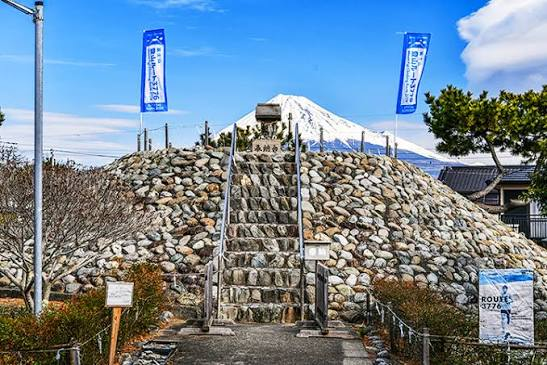
For those unable to climb Fuji itself, numerous miniature artificial mountains modeled on Fuji, called "Fujizuka," were built throughout Edo and elsewhere. Many were even built using real lava carried in from Mount Fuji to cover the surface, and climbing one was believed to confer the same blessing as climbing the real mountain. A number of Edo-era Fujizuka still survive today within Tokyo, some designated as Important Tangible Folk Cultural Properties.

A Fujizuka mound with stone steps, with the real Mt. Fuji visible behind it
A Fujizuka — believed to confer the same blessing as climbing Fuji itselfAn example of a Fujizuka at the foot of Mt. Fuji

The oshi

Lodging houses and guides who welcomed climbers at the foot of the mountain.

Fuji-ko pilgrims were received at the mountain's foot by figures called "oshi" — priests who offered their own homes as lodging houses, took care of pilgrims' food and rest, and also handled prayer rites and mountain guiding, serving as a bridge between the sacred and the everyday. In the Kamiyoshida district of Fujiyoshida City, Yamanashi, a townscape retaining traces of these historic oshi residences still survives in part, and is itself registered as a World Heritage component asset.

Next

Why is a mountain of faith not a "natural" but a "cultural" World Heritage site?

The history nurtured by Fuji-ko played a decisive role in Mount Fuji's World Heritage registration. The next page looks behind the scenes.

Read Behind the World Heritage →