Home / Eruption History

01 — Eruptions

That beautiful silhouette
is four volcanoes, stacked.

Mount Fuji isn't a single mountain. Hidden underground is a "mille-feuille" of at least four volcanic bodies: Sen-Komitake, Komitake, Old Fuji, and New Fuji. The symmetrical, beautiful ridgeline we see today was largely finished, relatively recently, by lava flowing from the New Fuji volcano over the past 10,000 years or so. And Fuji remains an active volcano, monitored around the clock by the Japan Meteorological Agency — never forget that.

The four-layer mille-feuille buried underground

Origins

Sen-Komitake, Komitake, Old Fuji, then New Fuji.

Around 700,000 to 200,000 years ago, a volcano called "Komitake" stood where Mount Fuji is today. Roughly 2,400 meters tall, it erupted viscous andesitic magma. In 2004, a University of Tokyo Earthquake Research Institute borehole survey discovered traces of an even older volcanic body beneath Komitake, dubbed "Sen-Komitake" ("pre-Komitake") — revealing that Fuji's origin story is more complex than once thought.

"Old Fuji" activity then began roughly 100,000 to 80,000 years ago, repeatedly erupting explosively and piling up ash and scoria to grow the mountain. But around 25,000 years ago, part of the mountain collapsed catastrophically in what's known as a "sector collapse," sending a huge volume of debris surging down the mountainside as the "Old Fuji debris avalanche." Part of the broad skirt of foothills seen today is a trace of this collapse.

Then, about 11,000 years ago, the eruption style changed dramatically. Explosive eruptions gave way to low-viscosity basaltic lava flowing out gently, rapidly building up the mountain over a relatively short period. This is the "New Fuji" phase, and the symmetrical, smooth ridgeline we see today was largely finished by these New Fuji lava flows.

Figures vary by source: The start dates and elevations for each volcanic body vary somewhat between surveys and sources. The figures here should be read as approximate guides.

The largest eruption on record

The Jogan Eruption — the 864 disaster that created the sea of trees.

During the Heian period, from 864 to 865 CE, a massive volume of basaltic lava erupted from Fuji's northwest flank (near present-day Nagao-yama). This is the "Jogan eruption." The lava flowed northwest on a massive scale, gradually burying a broad lake that then stood in the area, known as "Lake Se."

The lava flow split the lake in two, and it is said to have become today's Lake Shoji and Lake Sai. Over more than a thousand years, a forest grew atop the lava that flowed in this eruption — that forest is what we now call Aokigahara Jukai, the "sea of trees." In other words, the sea of trees is itself the scar of a great disaster caused by an eruption, and simultaneously an ecosystem regenerated from it. More on this in the "Sea of Trees" page.
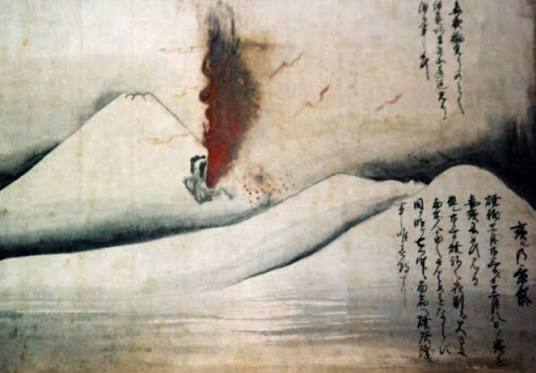
One of the largest in recorded history: The total volume of lava erupted is considered among the largest of any recorded Fuji eruption. The event is also described in the imperial court record "Nihon Sandai Jitsuroku."
An old painting depicting red smoke rising from the flank of a mountain
A traditional painting said to depict Mt. Fuji eruptingA later work — not a firsthand sketch of the actual Jogan eruption

The most recent eruption

The Hoei Eruption — not from the summit, but the flank.

The "Hoei eruption," which occurred in 1707 during the mid-Edo period, is the most recent eruption on record. Its defining feature is that it did not erupt from the summit crater, but from a new crater that opened on the southeastern flank — what is now known as the "Hoei crater." The small peak called Hoei-zan was newly created during this eruption.

The eruption was explosive, throwing up enormous quantities of pumice and volcanic ash. Carried by the westerlies, the ash reached all the way to Edo, and records from the time describe "ash falling on Edo." Unlike the Jogan eruption, this eruption involved almost no lava flow, but instead brought heavy ashfall over a wide area — an entirely different type of eruption.

And then, over 300 quiet years: From the Hoei eruption to the present day of 2026, Mount Fuji has not erupted. However, it remains one of the volcanoes under constant monitoring by the Japan Meteorological Agency — it is by no means a "finished" mountain in terms of volcanic activity.

Next

Walk through the forest that a great eruption created.

Aokigahara Jukai grew atop lava from the Jogan eruption, and it is home to both real geological facts and urban legends that spread online in odd coexistence. The next page sorts out both.

Read about the Sea of Trees →