How it formed
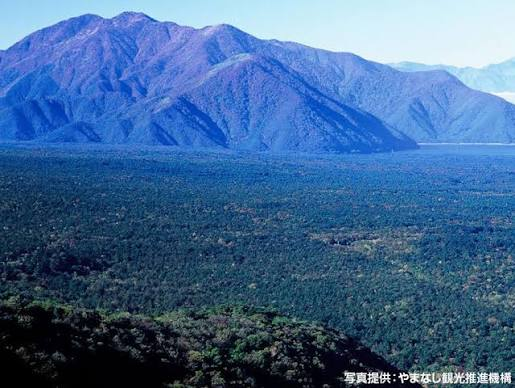
As covered on the "Eruption History" page, the foundation of Aokigahara Jukai is the lava flow from the 864 Jogan eruption. At the time, a broad body of water called "Lake Se" spread across the area, but a massive flow of lava poured in and buried the lake, splitting it — it's said to have become today's Lake Shoji and Lake Sai. The forest that has regenerated over more than a thousand years atop that lava-covered plateau is today's sea of trees.
It spans roughly 30 square kilometers — nearly half the area inside Tokyo's Yamanote loop line. Because lava sits just beneath the surface, the soil layer is extremely thin, and trees grow by spreading their roots across exposed lava rock. The distinctive scenery of roots crawling and tangling across the ground is a direct result of this "almost no soil" geological condition.
Common rumor #1
The most widely repeated rumor about the sea of trees is that "compasses go crazy and stop working." There is some basis for this. The lava covering the forest floor contains iron (magnetite), and it has been genuinely confirmed that a compass held directly against the ground or lava rock is measurably affected. NHK's "Burakamori Tamori" and several other verification pieces have reproduced this phenomenon.
Common rumor #2
Paired with the compass rumor is one about radio signals. There were once genuinely many spots deep in the forest with poor cell reception, but this comes down to ordinary difficulty of signals reaching through mountainous, forested terrain — common across Japan's mountains — rather than any effect from magnetite. Cell tower coverage has improved considerably in recent years.
As for GPS, satellite signals can be received wherever there's a clear view of the sky, and there is no scientific basis for the sea of trees uniquely blocking GPS. Positioning accuracy can drop under dense canopy, but that's the same as in any ordinary forest.
An ecological perspective
The sea of trees isn't just an eerie-looking forest — it hosts its own distinct ecosystem. Countless lava caves are scattered through it, and some serve as important hibernation and breeding sites for bat species such as the greater horseshoe bat. Together with the surrounding lakes, the area forms part of a landscape designated a national scenic spot and natural monument in places, and a site of academic survey interest.
A cave in the center of the sea of trees known as the "Lake Sai Bat Cave" is open to visitors and lets you observe both the lava geology and the ecosystem together — a spot long favored by researchers and enthusiasts from both a geological and biological angle.
Next
Underground beneath the sea of trees lies a network of caves carved by flowing lava. The next page explores this hidden landscape of wind caves and ice caves.
Read about the Lava Caves →